
What Is Actually in Oscillococcinum
Walk into a big Canadian pharmacy during cold season and you will often find two very different things on the same shelf. Real medicine that went through clinical trials, and homeopathic remedies that did not. They sit side by side in similar boxes with similar confident wording. That gap is what a group of Canadian skeptics decided to make noise about in 2012, and the clearest way to see their point is to look hard at one product.
By the time a 200C homeopathic remedy reaches the shelf, the arithmetic says not a single molecule of the original ingredient is likely to be left. What you carry to the till is sugar.
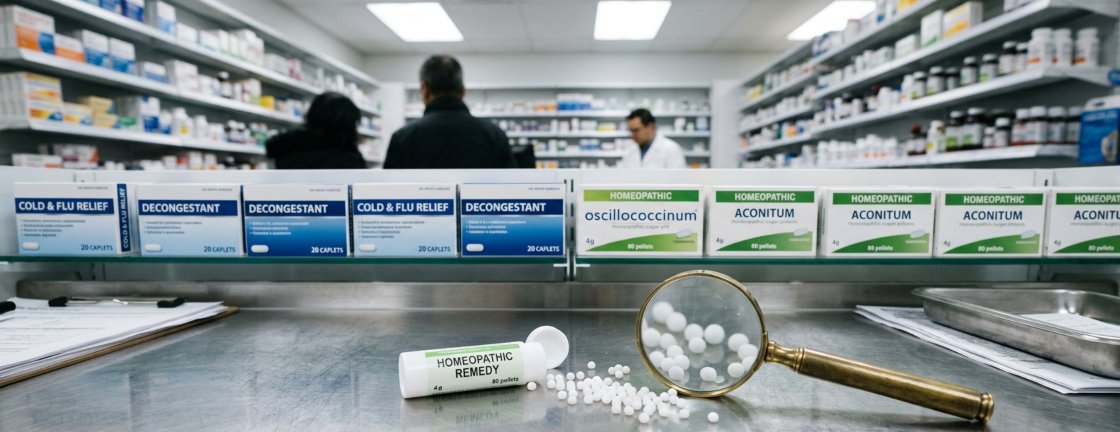
What the Box Promises
Oscillococcinum, made by the French company Boiron, is one of the best-selling flu products in the world. The packaging suggests it eases flu-like symptoms. The label, if you read it closely, tells a stranger story. Here is what the words mean.
| On the label | What it means |
|---|---|
| “200C” | Diluted one part in a hundred, then again, two hundred times over |
| Anas barbariae 200C | An extract of duck heart and liver, diluted past the point of disappearing |
| Active ingredient left | Effectively none |
| What you swallow | Small pills of sugar (sucrose and lactose) |
To put the dilution in plain terms: 200C means the starting material is watered down by a factor of 1 followed by 400 zeros. There is not that much matter in the observable universe. So, the duck extract on the label is best understood as a name, not an ingredient you will actually find in the pill.
The Idea Behind “There Is Nothing in It”
Skeptics have a blunt slogan for this, from an international campaign called 10:23: “there is nothing in it.” The point is not that homeopathy is weak medicine. It is that, after dilution on this scale, there is no active substance left to be weak or strong. Any effect people feel is the effect of time, rest, and expectation, the same things that make us feel better while a cold runs its course anyway.
The Open Letter to Shoppers Drug Mart
In January 2012, the week after CBC’s Marketplace took apart the claims behind another popular cold remedy, the team sent an open letter to Shoppers Drug Mart, Canada’s largest pharmacy chain. The ask was simple: stop selling homeopathic cold and flu products, Oscillococcinum among them, that contain none of the ingredient they advertise.
“It is unethical for pharmacists to knowingly sell ineffective health products.”
Steve Livingston, the CASS researcher behind the letter. He noted that the pharmacists they spoke to already knew these products were inert, yet the boxes still sat on the shelf next to treatments that work.
Their worry was placement as much as product. When a sugar pill sits next to a proven medicine, in matching packaging, a shopper with the flu can easily reach for the wrong one and pay a premium for it.

The Lawsuit
The pressure was not only a letter. In 2012 a $30 million class action was filed in Ontario against Boiron and Shoppers Drug Mart over the marketing of Oscillococcinum, with the Centre for Inquiry Canada acting as science advisor. The claim was that selling a product with no active ingredient as an effective flu remedy broke consumer-protection law.
Where This Leaves a Shopper
None of this is a reason to panic about your medicine cabinet, and it is certainly not a reason to drop a treatment your doctor gave you. It is a reason to read the box. If the strength is written as a C or an X number in the twenties or higher, you are almost certainly holding a sugar pill with a Latin name. For a cold, rest and fluids will do the same job for less money. For anything that worries you, a pharmacist or doctor beats the shelf.
The method behind this
Reading a health claim this way is a skill you can reuse. We wrote it up as a short guide – a simple way to check any health claim.
SOURCES AND FURTHER READING
- CASS open letter to Shoppers Drug Mart (January 2012), via the Internet Archive.
- The 10:23 campaign on homeopathic dilution.
- Centre for Inquiry Canada. centreforinquiry.ca
Disclaimer: This is an independent informational article. It is not affiliated with CASS or the Centre for Inquiry Canada, and it is not medical advice. Do not start or stop any treatment based on this page. If you have a health concern, ask a pharmacist or doctor.